Biological Background
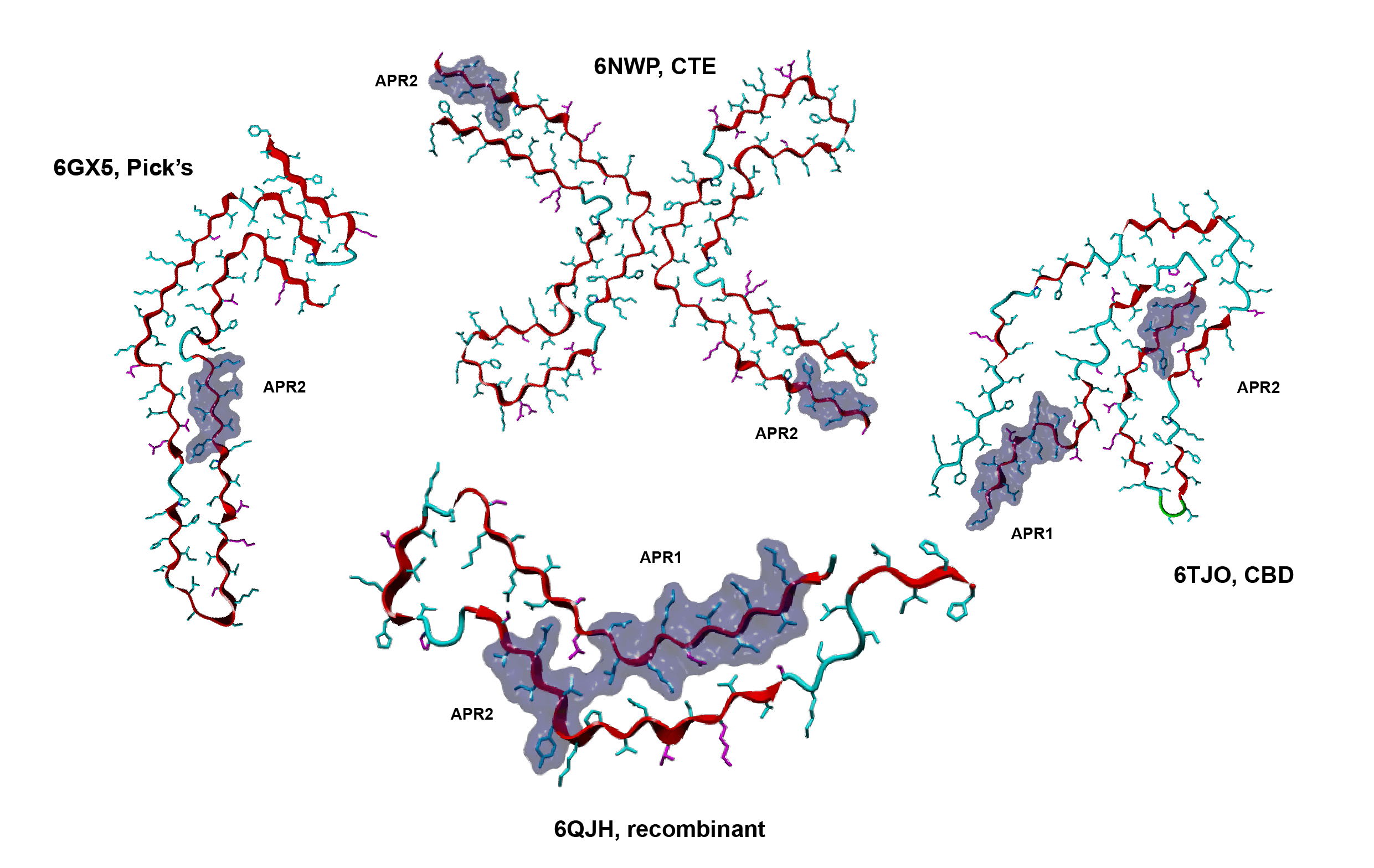
Due to the recent advancement in state-of-art structure determining methodologies, such as cryoEM and solid-state NMR, the interest in full-length amyloid fibril core structures is steadily growing beyond proportion. The atomic details from rapidly accumulating in vitro, as well as in vivo assembled amyloid fibrils are now providing invaluable information on previously undefined properties of amyloid aggregates, such as structural polymorphism, transmissibility patterns, mutation- and species-barriers, cross-interactions with cofactors and many more.
The amount of structures available has far exceeded what it was at the beginning of the 1980s for globular proteins (> 600 structures) which was sufficient to shape the first insights on general principles determining architecture and more fine-graded implications for protein function. Distinct amyloid pathologies are associated to the deposition of specific amyloid conformational variants of the same protein, which have already cultivated the interest to classify them based on disease type and/or levels of intermolecular interactions.
__
Functionality
Database Browsing
- Full listing of the database entries
- Available sorting selections by alphabetic order by clicking on the browsing table headers (Protein Name, PDB ID, Structure-determining methodology, resolution, disease, author)
- Filtering options are available for each browsing table header
- Filtering is also available for structures corresponding to specific disease mutations, types and whether or not they derive from in vitro or patient-extracted material
- Specific protein entries can be visualised by clicking on a row in the browsing table
Protein Entry Page mode
- Protein sequence section
Dynamically highlighted content on disease mutations, experimentally determined aggregation prone regions, and amyloid polymorph lengths
- Molecular Graphics Visualisation
Molecular graphic plugin interface that supports viewing of structural polymorphs. It includes multiple visualisation options, such as graphical models (ball-and-stick, ribbon, cartoon representation and more) and colour-coded scaling.
- Thermodynamic profiling
Dynamic interface indicating per residue energy contributions on the overall structural stability of user-selected amyloid polymorphs.
User data submission
Amyloid Explorer welcomes active submissions of new fibril structures by the community
Users can submit a novel amyloid fibril structure usign the Submit button on the top-right corner when browsing through the database.
A complete submission form requires the protein name, PDB ID and PDB coordinate file. Upon submission, the data will be manually curated for additional content (disease-mutations, aggregation prone regions) and subjected to automated analysis (thermodynamic profiling using the FoldX force field and cross-correlation analysis using Yasara superpositioning).
For additions to existing entries, user can communicate via amyloid-explorer@switchlab.com
Download options
- Description content, as shown in the browsing table, both for user-filtered subsets and unfiltered, can be downloaded in text format using the download option
- PDB files of structural polymorphs, both for user-filtered subsets and unfiltered, can be downloaded using the download option
- Downloading selections are also available for selected polymorphs through individual protein entry pages
__
External links
Amyloid Explorer database contains external links to databases with related content on experimentally determined aggregation prone regions
******
References
- Louros N, van der Kant R, Schymkowitz J, Rousseau F (2022) StAmP-DB: A platform for structures of polymorphic amyloid fibril cores. Bioinformatics. doi:10.1093/bioinformatics/btac126
- Van der Kant R, Louros N, Rousseau F & Schymkowitz J. A structural analysis of amyloid polymorphism in disease: clues for selective vulnerability? bioRxiv 2021.03.01.433317; doi: https://doi.org/10.1101/2021.03.01.433317
- Schymkowitz, J., et al. (2005) The FoldX web server: an online force field, Nucleic Acids Res, 33, W382-388.
- Louros, N. et al. (2019) WALTZ-DB 2.0: an updated database containing structural information of experimentally determined amyloid-forming peptides. Nucleic Acids Res, 48 (D1), D389–D393. https://doi.org/10.1093/nar/gkz758